
Objektorientiertes Design und Programmierung
Marcel Lüthi
Departement Mathematik und Informatik
Objektorientierte Programmiersprachen
Objektorientierte Design
“Pertaining to a technique or a programming language that supports objects, classes, and inheritance.”
ISO/IEC 2382-15
“OOP to me means only messaging, local retention and protection and hiding of state-process, and extreme late-binding of all things.”
A. Kay
Design und Programmiersprache
Wichtig beim OO Design sind Prinzipien (Information Hiding, Modularisierung, late binding), nicht die Programmiersprache.
- OO Sprachen helfen Design direkt abzubilden
- Nicht OO Sprachen verlangen Mehraufwand / Disziplin

- Gutes Beispiel für OO Design in C: GTK+
Terminologie
- Klasse implementiert Abstrakten Datentyp
- Daten heissen Attribute
- Konstruktor kreiert neue Instanzen
- Operationen heissen Methoden
- Instanzvariablen sind Referenzen auf Objekte
- Laufzeitstruktur die Menge der Objekte zur Laufzeit
- Jedes Objekt ist zur Laufzeit eindeutig identifiziert
Schnittstellen
Nutzung der Funktionalität eines Objekts nur über wohldefinierte Schnittstellen.
- Mehrere Objekte können gleiche Schnittstelle anbieten
- Ein Objekt kann mehrere Schnittstellen anbieten
Beispiel aus Java:
                    public class ArrayList<E> extends AbstractList<E>
                            implements List<E>,
                            RandomAccess
Dynamische Bindung und Polymorphismus
- Polymorphismus: Variablen können zur Laufzeit an verschiedene (verwandte) Typen gebunden werden
- Dynamische Bindung (late binding): Zur Laufzeit wird Methode entsprechend dem Objekttyp verwendet.
Beispiel: Polymorphismus
                        interface Foo {
                            public void bar();
                        }
                        class FooImpl1 implements Foo {
                            public void bar() { System.out.println("in FooImpl1"); }
                        }
                        class FooImpl2 implements Foo {
                            public void bar() { System.out.println("in FooImpl2"); }
                        }
                        void doSomethingWithFoo(Foo foo) {
                            foo.bar();
                        }

                        if (condition)
                            doSomethingWithFoo(new FooImpl1())
                        else
                            doSomethingWithFoo(new FooImpl2())
- Unterschiedliche Ausgabe je nachdem ob
foo anFooImpl1 oderFooImpl2 gebunden wird.
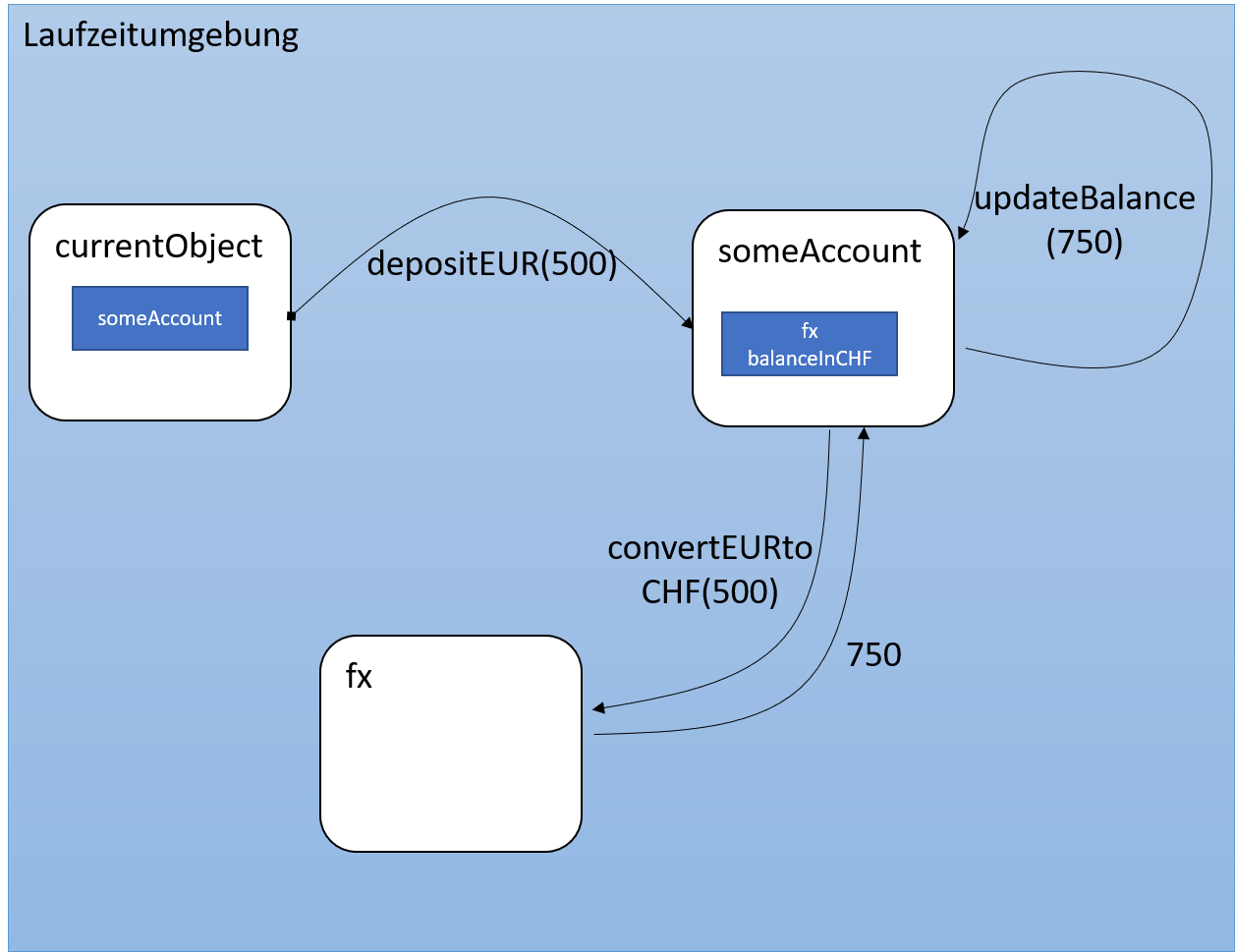
Objektorientierung als "Messaging"
- Objekte verwalten Zustand der Daten (Attribute)
- Nehmen Nachrichten/Requests entgegen (Methoden)
- Senden Antwort zurück und/oder verändern Zustand

Methodenaufruf = senden einer Nachricht
Beispiel: Methodenaufruf als Nachricht
                    class BankAccount {
                      private FxConverter fx = new FxConverter();
                      private double balanceCHF;

                      void depositEur(double amount) {
                        double asCHF = b.convertEurToCHF(amount))
                          this.updateBalance(balanceCHF + asCHF)
                      }
                      void updateBalance(double newBalance) {
                        balanceInCHF = newBalance;
                      }
                    }

                    // somewhere in currentObject
                    someAccount.depositEUR(500);
OO Design - Zusammenfassung
- Aufteilen eines Systems in Module
- Objekte verwalten Daten
- Zugriff nur via Methoden
- Interpretation: Kommunikation via messaging
- Late binding: Es wird erst zur Laufzeit entschieden welches Objekt Nachricht erhält/bearbeitet